
GitHub repository
The aim of the project is to show how it is possible to control a clamp and its rotation through a signal from some sensors such as an inertial sensor and an electromyography sensor. The structure is very simple and is designed in full accordance with the Maker philosophy, trying to exploit salvaged objects with the sole purpose of showing the idea behind it.
The gripper is made in three different ways, but the same project can be accomplished by purchasing a robot gripper directly. One possibility is to make it with two gears, connecting one to the servomotor and connecting the two arms of the gripper directly to the gears.
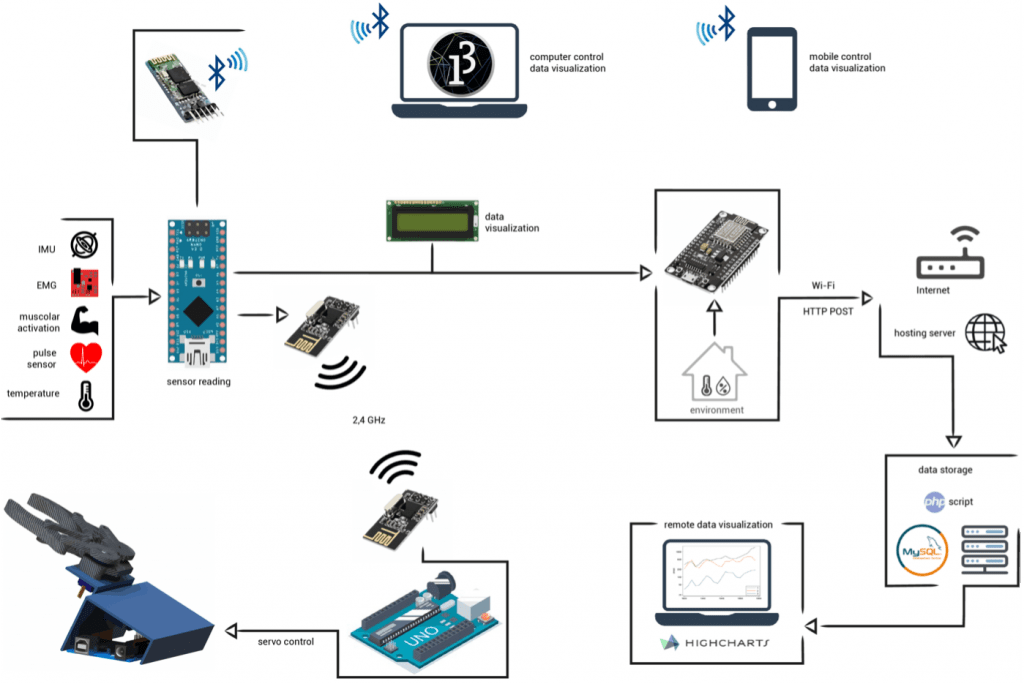
The overall architecture of the project includes different levels. It starts with an Arduino Nano that must read the sensors, IMU and electromyography, and does a first processing of the signal obtaining some synthetic parameters that it sends, through a 2.4 GHz radio communication to an Arduino Uno to which the two servos are connected.
The Arduino Uno also communicates via Bluetooth with both mobile devices and computers.
In addition, there is a module, an ESP 8266 that allows you to collect data and send it to a server under a proprietary domain through which it is possible to save data and view them remotely.
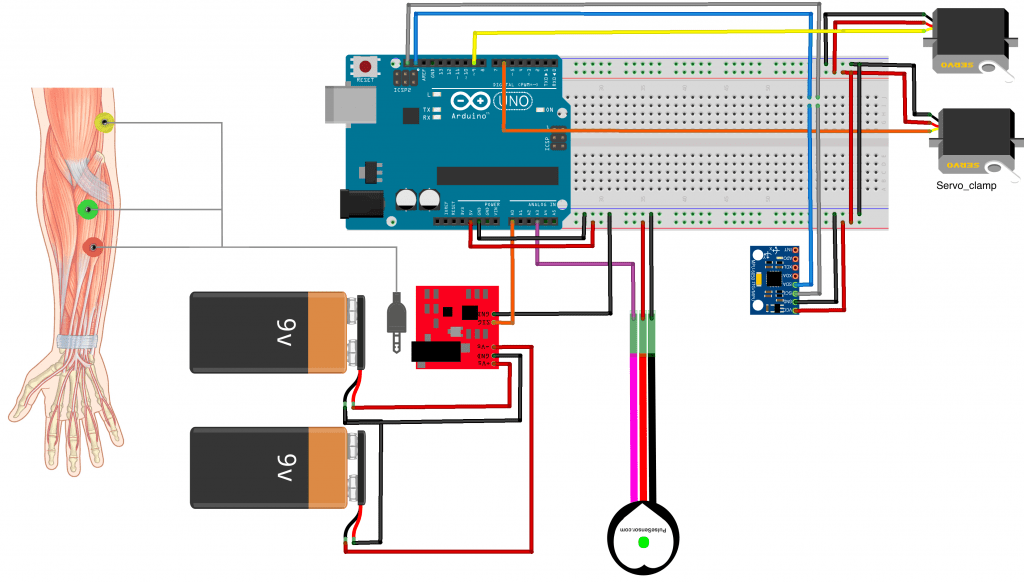
An inertial sensor is used to read the inclination of the wrist and control the rotation of the caliper, this sensor also includes a temperature sensor that is exploited with the idea of collecting the user’s temperature. In addition, an electromyography sensor is also used to measure muscle activity in order to adjust the closing or opening of the clamp.
Read more: https://github.com/mastroalex/progelettronica
Design

Course of Elettronica II
The structure is very simple and was designed in full of the Maker philosophy, trying to exploit salvaged objects with the sole purpose of showing the idea behind it. An example:
The gripper was made in three different ways, but the same project can be accomplished by purchasing a robot gripper directly. One possibility is to make it with two gears, connecting one to the servomotor and connecting the two arms of the caliper directly to the gears.
The overall architecture of the project includes different levels. It starts with an Arduino Nano that must read the sensors and does a first processing of the signal obtaining some synthetic parameters that it sends, through a 2.4 GHz radio communication to an Arduino Uno to which the two servos that move the plier.
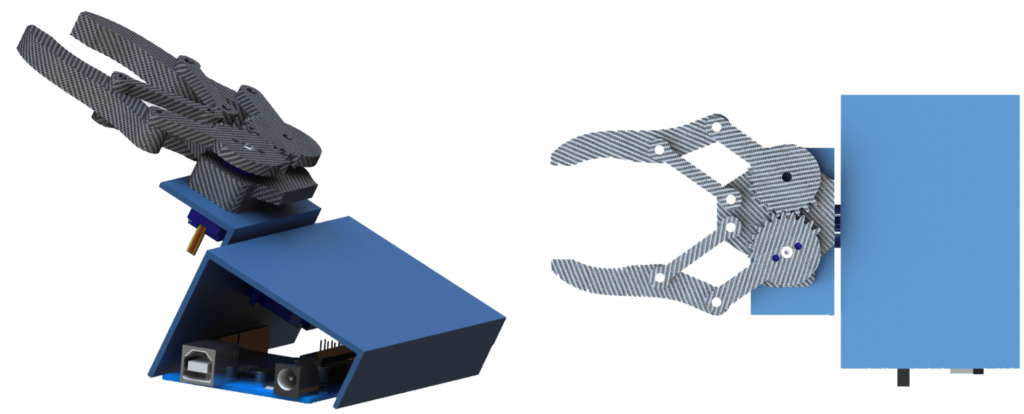
Example of the structure to controll opening and closing of the gripper
The Arduino Uno also communicates via Bluetooth with both mobile devices and computers.
In addition, a module has been added, an ESP 8266 that allows data to be collected and sent to a server under a proprietary domain through which data can be saved and viewed remotely.
An inertial sensor was used to read the inclination of the wrist and control the rotation of the caliper, this sensor also includes a temperature sensor that was exploited with the idea of collecting the user’s temperature. In addition, a sensor for electromyography was also used to measure muscle activity in order to adjust the closing or opening of the forceps.
We propose below the other two construction methods of the caliper. A possible realization of the gripper can be carried out using plywood Fig. 3. For the design we start from the design of the various components on the plywood, then proceed with the cutting and finally the assembly. The Arduino Uno with the transceiver, the bluetooth module and the two servos that control the rotation and the opening-closing of the clamp was mounted above the base that supports the clamp.
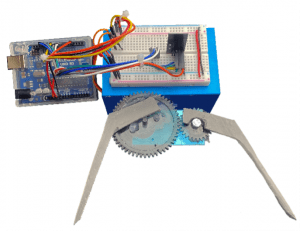
Example of a structure made with gears, shaped plastic and an anodized aluminum base
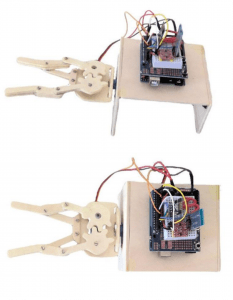
Plywood gripper model
Also in this case one of the gears was connected to a servo while the base that contains the caliper and allows it to rotate was connected to the other servo.
Autori
- Mastrofini Alessandro
- Volpato Rebecca
You can find a step-by-step report with further details, complete codes and fritzing connection diagrams on the repository: github.com/mastroalex/progelettronica