
I just finished the “Wolfram Mathematica Masterclass: from Beginner to Expert” course held on the Udemy online platform by Dr. Börge Göbel.
The course allowed me to refine the already established Skills within the Wolfram Mathematica environment and to touch further practical projects.
Mathematica
Wolfram Mathematica is a very powerful tool. It allows, with a very compact language, to solve even complex problems with a few lines of code. It therefore offers a different approach and requires a transition from conventional programming to a more symbolic approach.
In addition, the software has numerous pre-installed libraries that allow you to work in different computational areas such as machine learning. statistics, symbolic calculation, data analysis and much more.
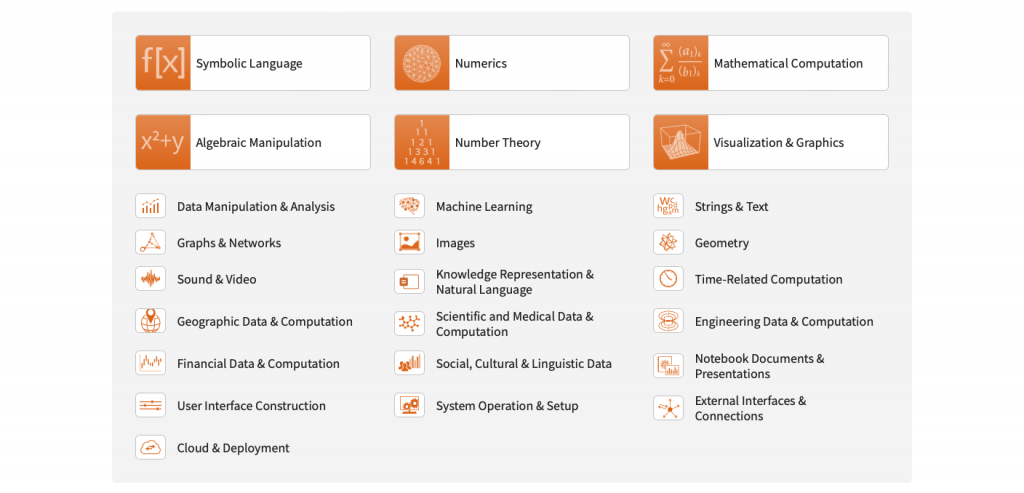
It was invented by Stephen Wolfram and the first version was presented in 1988 along with the same development of the Mathematica language. After more than 30 years of development, the thirteenth version is now being published.
Notebook
Today, the language provides access to computing power at extraordinary levels by exploiting algorithms and knowledge developed over three decades. Furthermore, Mathematica codes can be adapted to local computational or cloud scaled.
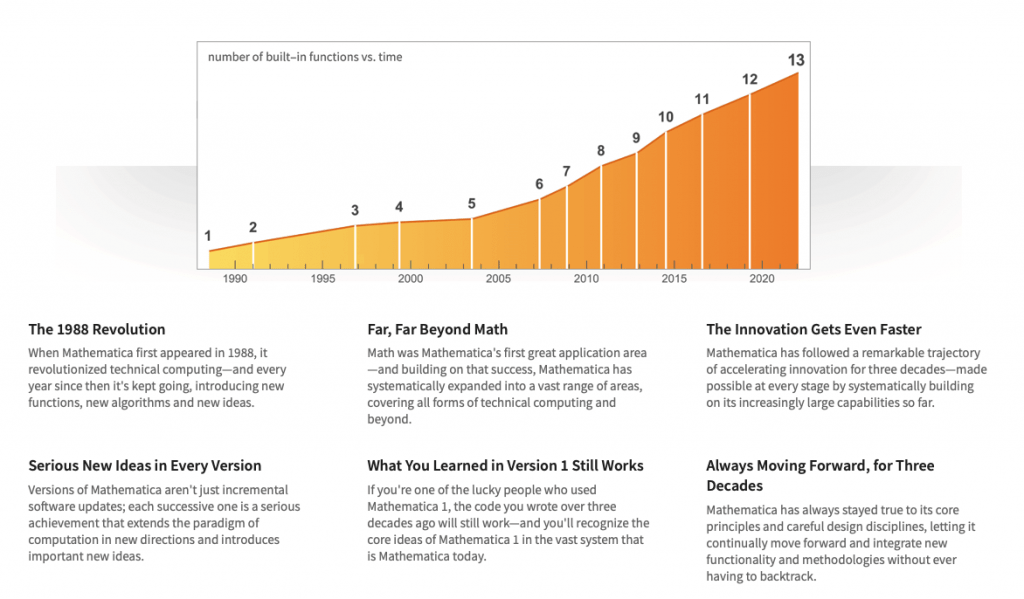
Da wolfram.com
Furthermore, the Mathematica language interacts perfectly with interactive documents called Notebooks. Therefore these documents, with the .nb extension, can contain code, text, graphics, sounds and can be edited on desktop, mobile and cloud.
From the basics to advanced projects
The course is divided into three macro sections:
- Fundamentals of Mathematica programming
- Basic skills such as functions, lists, graphics and animations
- Practical projects
In other words, within the practical projects, various hot topics are treated in the following macro-topics:
- Statistics
- Chemistry and biology
- Machine learning
- Image processing
- Linguistics and social-historical analysis
- Analysis of sounds
- Physics
Applications
In fact, I’ve already leveraged this powerful tool for some projects: