
Humans are not supposed to breathe underwater.
It is an obvious statement, but it feels surprisingly different when you are several meters below the surface, breathing normally, looking up and realizing that there is a considerable amount of water between you and the place where you actually belong. This summer, I started scuba diving. What began with an Open Water certification quickly turned into an Advanced certification and, shortly after that, into the realization that I wanted to take diving more seriously. I moved toward a more technical configuration, switched to a backplate-and-wing BCD, and bought a drysuit so that winter would not become a reason to stop diving.
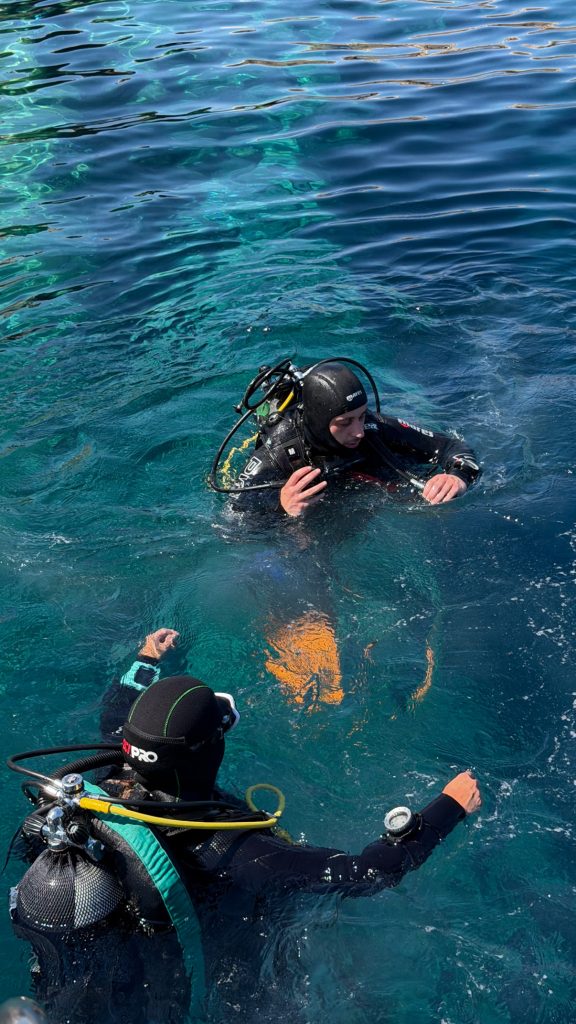
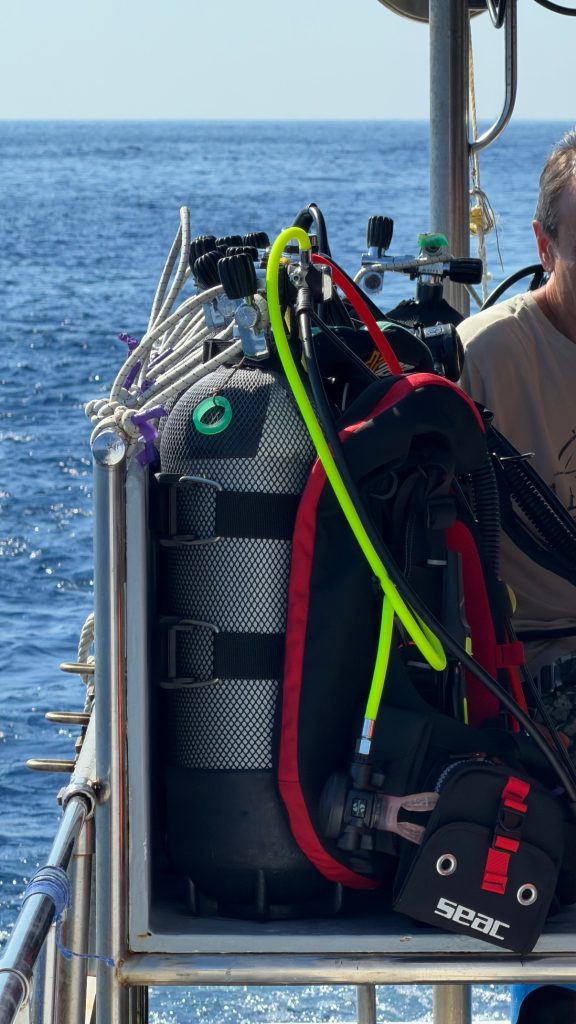
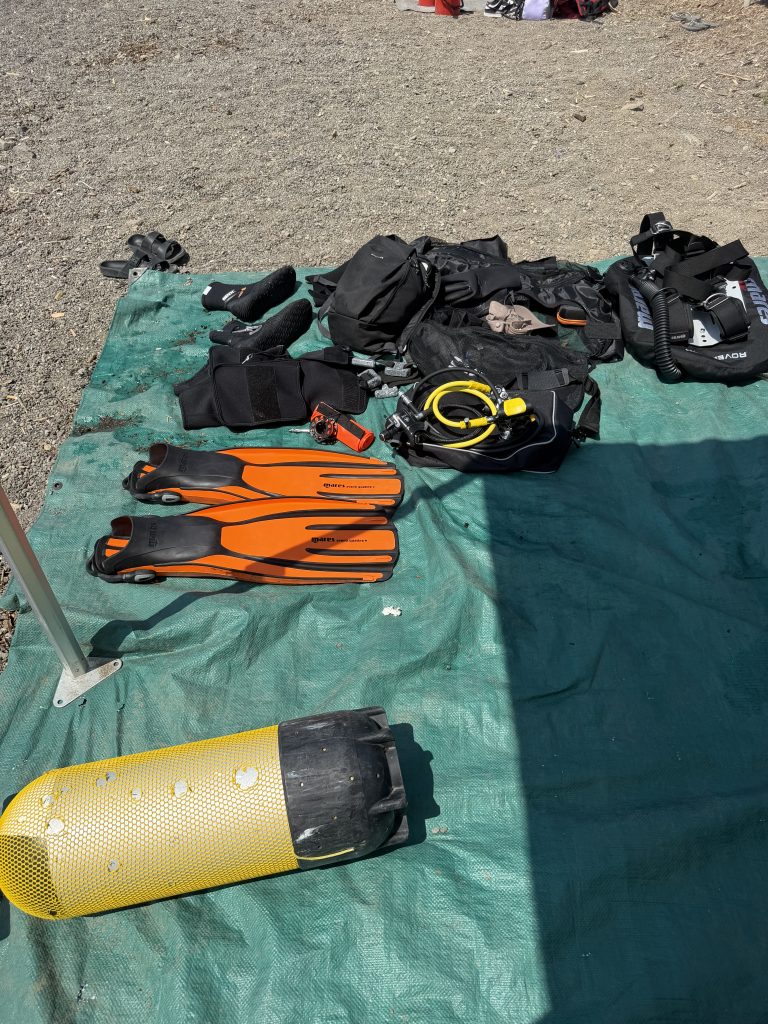
Apparently, discovering a new environment was not enough. I also needed new equipment.
Breathing Where We Shouldn’t
What fascinates me about scuba diving is that almost everything we normally take for granted changes underwater.
At sea level, we live at approximately one atmosphere of pressure. Descend to 10 meters and the ambient pressure is already about twice that: one atmosphere from the air above us and another from the water.
At 20 meters, it is roughly three atmospheres.
According to Boyle’s law,
so, for a flexible gas volume, increasing pressure means decreasing volume.
A balloon containing one liter of air at the surface would occupy roughly half that volume at 10 meters if it were taken down without adding more gas. Our lungs are subject to the same basic physics. The reason we can breathe normally while diving is that the regulator does not simply give us air from a tank: it delivers it at approximately the same pressure as the surrounding water.
The deeper we go, the higher the pressure of every breath. It is a remarkably elegant technological solution to a rather fundamental biological problem: our respiratory system was designed to work in air, not underneath tens of meters of water.
When Air Changes Its Rules
Pressure does not only affect volume. The air in a scuba cylinder is still mostly nitrogen and oxygen, but increasing ambient pressure increases their partial pressures.
Dalton’s law gives
where (Fi) is the fraction of a gas in the mixture. At the surface, nitrogen has a partial pressure of roughly (0.79) bar. At 30 meters, where the absolute pressure is about (4) bar, its partial pressure is already around (3.16) bar. That matters because, as pressure increases, more nitrogen can dissolve into our tissues. Stay deep enough for long enough and the body accumulates a significant amount of it.
Going back up therefore becomes part of the dive itself. Ascending too quickly can cause dissolved inert gas to come out of solution faster than the body can eliminate it, potentially forming bubbles in tissues and blood. This is the basic reason behind decompression limits, controlled ascent rates and safety stops.
Partial pressure of oxygen.
The strange thing is that none of this is visible. You can be floating peacefully in perfectly clear water while your body is quietly following physical laws discovered long before scuba diving existed.
Learning to Become Weightless
Then there is buoyancy. A diver does not simply sink to the bottom and swim around. Much of learning to dive is actually about learning how to become almost weightless. The wing contains air. The drysuit contains air. Our lungs contain air. Even the cylinder changes during the dive as we consume the gas inside it.
All of these affect buoyancy.
With a drysuit, the effect becomes particularly obvious. Descend and the gas inside the suit compresses, reducing its volume and therefore its buoyancy. You add gas to compensate. Ascend and that same gas expands, so it has to be released before the expansion accelerates you toward the surface.
It becomes a continuous feedback loop:
flowchart LR
    A["Pressure changes"] --> B["Gas volume changes"]
    B --> C["Buoyancy changes"]
    C --> D["Diver adds or releases gas"]
    D --> A
Eventually, the goal is to stop consciously thinking about it. A small breath makes you rise slightly. Exhaling makes you descend. With good trim and neutral buoyancy, you can remain almost motionless in three dimensions. For someone interested in mechanics, it is difficult not to appreciate how physical the entire experience is.
From Open Water to a More Technical Setup
I started with the Open Water certification and quickly continued with the Advanced course. At the same time, I realized that I was particularly attracted to the more technical side of diving: equipment configuration, buoyancy, trim, gas management and the idea of progressively becoming more comfortable and controlled underwater.
That also influenced my equipment choices. I moved quite early to a backplate-and-wing configuration: a rigid backplate, a simple harness and an inflatable wing positioned behind the diver. Instead of wrapping an air bladder around the body, buoyancy is concentrated behind you. The configuration is simple, modular and naturally suited to maintaining a horizontal position underwater.
Then came the drysuit. Rather than accepting that scuba diving would mostly be a warm-weather activity, I wanted to continue through winter. A drysuit introduces another gas space to manage and therefore another layer of buoyancy control, but it also dramatically changes where and when diving is possible. It felt like a natural progression: if I wanted to learn properly, I did not want winter to interrupt the process.
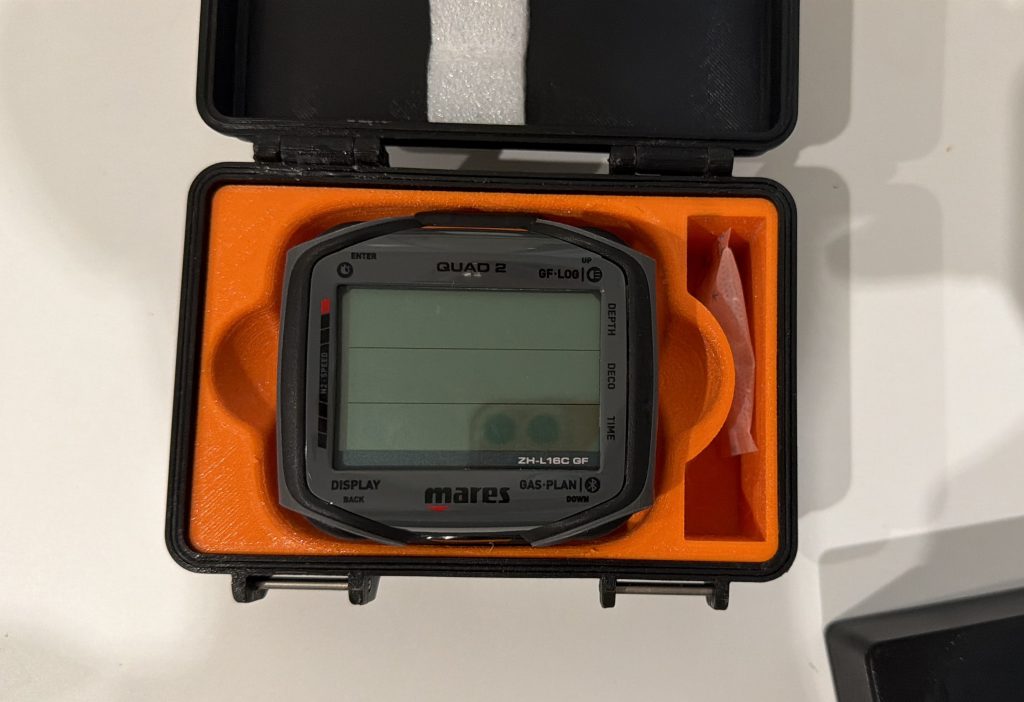
Custom 3D-printed enclosure, using rigid PETG for the main body and flexible orange TPU to securely hold the scuba computer.
Technology as Life Support
Perhaps this is the part of scuba diving that I find most fascinating. A lot of sports use technology to make us faster, stronger or more efficient. In scuba diving, technology allows us to temporarily exist somewhere we fundamentally cannot.
The cylinder carries several thousand liters of gas compressed into something small enough to wear on our back. The regulator reduces that enormous pressure and delivers gas according to the pressure around us. The wing controls our position in the water column. The drysuit isolates us from an environment that can remove heat from the body far more efficiently than air.
None of these systems changes what we are. They simply compensate, one by one, for the reasons why we should not be there.
Where We Don’t Belong
And I think this is what has attracted me most to scuba diving. It is not really about pretending that humans suddenly belong underwater.
We don’t.
Without the equipment on our backs, a functioning regulator, appropriate exposure protection and an understanding of what pressure is doing to our bodies, our ability to remain there disappears very quickly. Instead, diving is about learning the rules of an environment that was never designed for us. You learn to breathe gas at ambient pressure. You learn that ten meters of water can matter enormously.
You learn to control expanding and compressing volumes of air. You learn that returning to the surface is a process rather than simply a direction. And eventually something strange happens. You stop fighting the water.
For a limited amount of time, carrying a small life-support system on your back and surrounded by an environment in which you cannot naturally breathe, you become neutrally buoyant, settle into trim, and simply stay there.
Still somewhere we don’t belong.
Just slightly better adapted to it.